Lake Dallas, TX · Denton County
Basement Water Removal in Lake Dallas, TXBasement Wall Drying & Emergency Basement Flooding
Homeowners in Lake Dallas get Basement Water Removal for basement floor water damage, basement water pump out and basement moisture inspection.
Answered 24/7
Expert Basement Water Removal in Lake Dallas, Hickory Creek, Highland Village and Corinth
In Lake Dallas, a finished basement or lower level takes more work after a flood. Carpet, pad, laminate, drywall and insulation all trap water against the concrete and framing.
Few homes in Lake Dallas are built with basements, so these steps are usually applied to the lowest rooms of a house, a garage or a crawl space instead.
A finished basement or lower level in Lake Dallas or Hickory Creek, Highland Village and Corinth can hide water under flooring and behind drywall. The pros find and remove it before it causes lasting damage.
Basement Water Removal Services in Lake Dallas
Basement Wall Drying
Basement walls are checked with moisture meters. Wet drywall is cut back above the water line, and insulation behind it is removed.
Emergency Basement Flooding
Help is available any hour when water is rising in the basement from a storm, a sewer backup or a burst pipe.
Basement Water Pump Out
A pump-out removes standing water from the basement with submersible pumps, discharging it outside and away from the foundation.
Basement Moisture Inspection
An inspection shows how high water wicked up the walls and how far it spread under flooring, which sets the drying plan.
Basement Drying Services
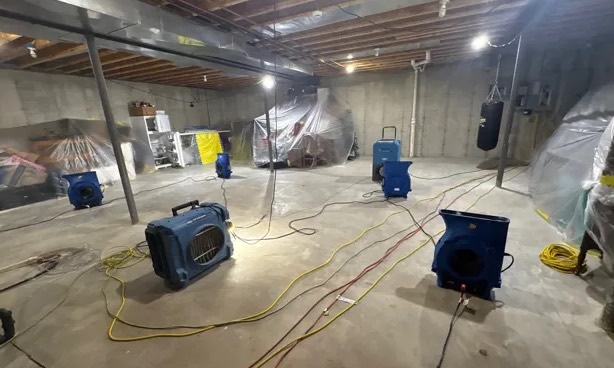
After pumping, air movers and dehumidifiers dry the walls, framing and slab. Readings are taken daily until every surface is back to normal.
Common Symptoms Requiring Basement Water Removal
Standing Water in Basement
Standing water anywhere on the basement floor needs to be pumped out before it soaks the walls.
Water Stains on Walls or Ceiling
Stains on lower walls or the ceiling below a bathroom or kitchen point to a leak.
High Humidity and Condensation
Water on pipes and windows, or a constantly clammy feel, means basement humidity is too high.
Wet or Damp Basement Walls
Basement walls that look dark, feel damp or show tide lines are taking on or holding water.
How Basement Water Removal Works in Lake Dallas
Step 1: Safety Assessment and Pump Out
Electrical hazards are checked, then deep water is pumped outside away from the foundation.
Step 2: Content Removal and Damage Documentation
Wet belongings are moved, and photos record the water level and damaged materials.
Step 3: Targeted Water Removal and Drying
Carpet is extracted, wet drywall is cut back and air is aimed at walls and the slab.
Step 4: Sanitization and Moisture Control
Surfaces touched by dirty water are disinfected, and dehumidifiers keep humidity low.
Common Causes of Basement Water Damage in Lake Dallas
Improper Landscape Grading
Soil that slopes toward the house directs rainwater straight to the basement walls.
Appliance Malfunctions and Overflows
Washers, utility sinks and water softeners in the basement can overflow or leak.
Heavy Rainfall and Storm Flooding
Heavy rain saturates the soil and pushes water through walls, cracks and the floor joint.
Sewer Line Backups and Blockages
A blocked sewer line can push wastewater up through basement floor drains and toilets.
Residential and Commercial Basement Water Removal in Lake Dallas
Residential Basement Water Removal
In homes, a wet basement often means damaged carpet, drywall and stored belongings, plus a furnace or water heater sitting in water. Water is pumped out and the space dried.
Commercial Basement Water Removal
In commercial buildings, basements often house mechanical rooms and storage. Water is removed so systems can be checked to determine whether they can be restarted safely.
The Risks of DIY Basement Water Removal
Checking appliance hoses and extending downspouts away from the house are good DIY steps before storm season. Once the basement floods, call (972) 736-7408 for help.
Basement Water Removal Cost in Lake Dallas, TX
The pros look at water depth, water type and basement finishes before pricing basement water removal in Lake Dallas, then explain the scope.
Basement Square Footage
Larger basements need more extraction, more drying equipment and more days of drying.
Access and Complexity
Narrow stairs, low ceilings and crowded storage areas make the work slower and longer.
Water Depth and Volume
Deeper water takes more pumping time and usually means more materials got wet.
Does Insurance Cover Basement Water Removal?
Ask your adjuster early how your policy treats seepage and sewer backups, since many policies limit or exclude both kinds of water.
Advantages of Local Basement Water Removal Experts
24/7 Emergency Response
Help is available day or night when water is rising in the basement.
Detailed Damage Documentation
Photos, readings and drying logs are kept to support your insurance claim.
Focus on Drying Outcomes
Drying continues until readings are normal, not just until surfaces look dry.
Emergency Basement Water Removal Available 24/7
The faster a basement is pumped out, the more can be saved. Call (972) 736-7408 for basement water removal in Lake Dallas as soon as you see water.
Call Now (972) 736-7408Basement Water Removal Throughout Denton County
Need basement water removal outside Lake Dallas? Service also covers Hickory Creek, Highland Village and Corinth, including emergency help during storms.
- Basement Water Removal in Hickory Creek
- Basement Water Removal in Highland Village
- Basement Water Removal in Corinth
- Basement Water Removal in Shady Shores
- Basement Water Removal in Copper Canyon
- Basement Water Removal in Double Oak
- Basement Water Removal in Lewisville
- Basement Water Removal in Flower Mound
- Emergency Damage Restoration in 75065
- Storm Damage Restoration in 75065
- Water Damage Restoration in 75065
- Water Extraction Service in 75065
- Water Leak Detection in 75065
- Water Removal Service in 75065
Basement Water Removal in Lake Dallas: Your Questions
What causes basement floor water damage?
Storm seepage, burst pipes, appliance leaks, foundation cracks and sewer backups through floor drains are the usual sources.
What equipment is used for basement water extraction?
Submersible pumps, extractors, wet vacs, air movers, large dehumidifiers and moisture meters to confirm drying.
How does a basement moisture inspection work?
Moisture meters and thermal cameras check walls, floors and the slab, including behind finished walls and under flooring.
Can wet drywall in a basement be saved?
Sometimes, if the water was clean and removed quickly. Soaked or contaminated drywall is cut out above the water line.
Can I dry my basement myself with fans?
Fans help with surface water, but walls and concrete need dehumidifiers and readings to dry fully.